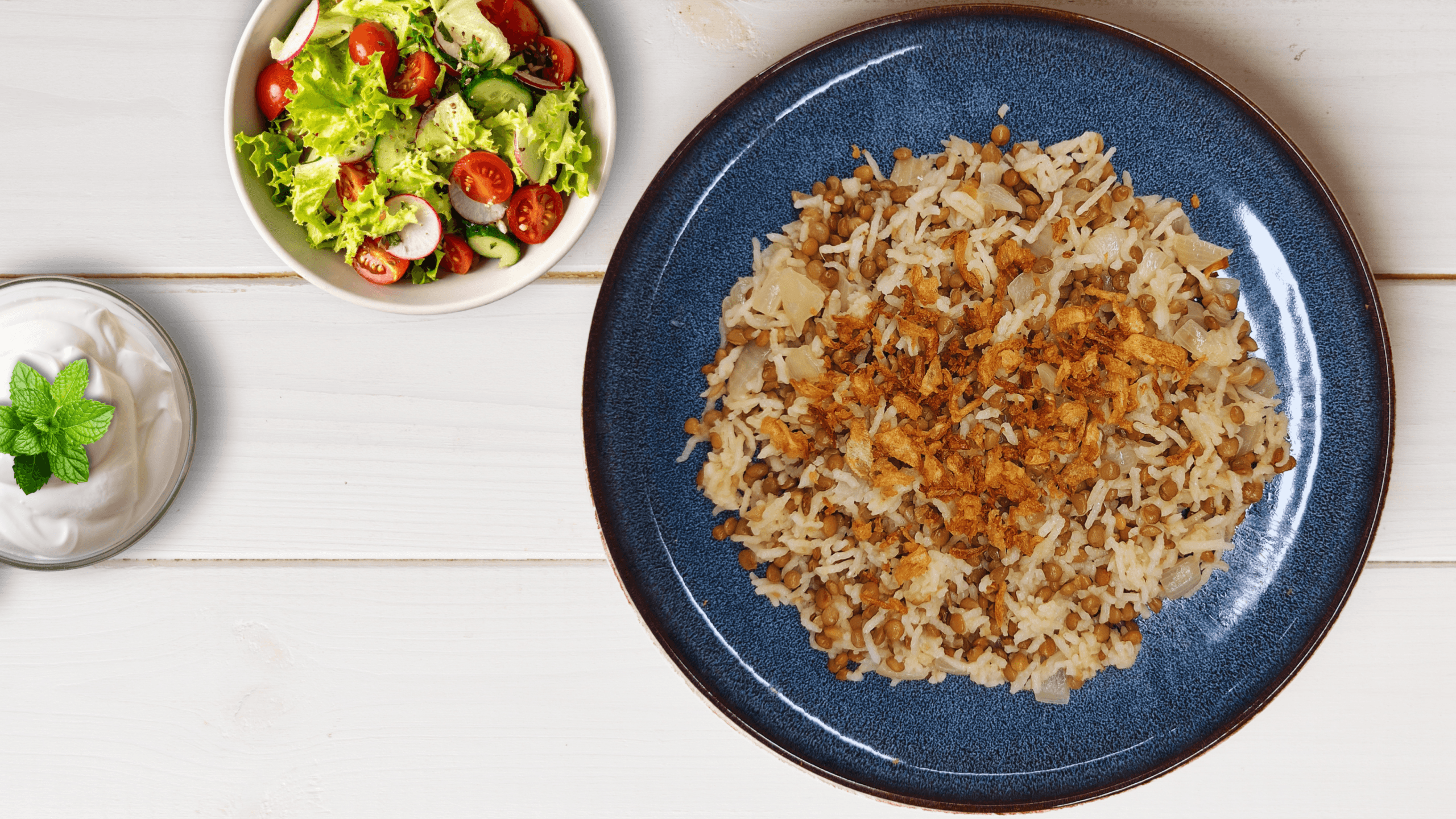
Mujadara is a classic Lebanese dish of lentils and rice topped with deeply browned onions. Simple, filling and built from inexpensive pantry staples, it is known for the contrast between earthy lentils, tender rice and the sweet, savory richness of the onions.
What is Mujadara?
Mujadara is made by cooking lentils with rice or another grain, then serving the mixture with a generous amount of browned or fried onions. In Lebanese versions, rice is common, although bulgur-based preparations also exist.
The dish is intentionally simple, but the onions are essential rather than decorative. Their sweetness and crisp edges balance the earthy lentils and give Mujadara much of its characteristic depth and texture.
Mujadara in Lebanese food culture
Mujadara has a strong place in Lebanese home cooking, where its combination of lentils, rice and onions makes it an economical and satisfying everyday meal. Because it relies on simple pantry staples and contains no meat, it is also a practical dish for meatless meals while still being substantial enough to serve as a main course.
It is commonly served with yogurt and a fresh salad, which provide coolness and acidity alongside the earthy lentils and rich onions. Its simplicity is part of its identity: Mujadara is less about elaborate ingredients than about turning a few basic foods into a deeply comforting meal.
What does Mujadara taste like?
Mujadara has an earthy, savory flavor from the lentils, softened by the mildness of the rice and enriched by olive oil. Cumin adds gentle warmth, while the onions bring sweetness and a deeper roasted character.
The contrast in texture is just as important as the flavor. The rice and lentils are soft and tender, while the fried onions add crispness and a concentrated savory-sweet finish that keeps the dish from feeling plain.
How Mujadara varies
Mujadara appears in several forms across Lebanon and the wider Levant. Some versions are made with rice, while others use bulgur, and the proportion of lentils to grain can vary considerably from one household to another.
Texture also differs by style. Some preparations keep the lentils and grains distinct, while others are cooked until softer and more cohesive. The onions may be slowly caramelized, deeply browned or fried until crisp, but they remain one of the defining elements of the dish.
Where does Mujadara come from?
Mujadara has a long history in Middle Eastern cooking and is especially associated today with the cuisines of the Levant, including Lebanon, Syria, Palestine and Jordan. The exact place where the dish first developed is difficult to identify, and it is better understood as part of a wider regional tradition of cooking lentils with grains.
A recipe bearing the name appears in a 13th-century Arabic cookbook compiled by al-Baghdadi, showing that Mujadara has been part of the region’s food culture for centuries. Over time, simpler meatless versions built around lentils, rice or bulgur and onions became everyday staples across the Levant.
Make Mujadara at home
Ready to make it yourself? Follow the full Lebanese Mujadara recipe with ingredients, step-by-step instructions, recipe notes and video.